Imagine doubling your ₹15,000 investment in just one week—without doing any hard work. Sounds like a scam, right? But in the Indian stock market, this magic actually happens, and it’s called an IPO (Initial Public Offering).
Whenever a massive brand like Tata, Bajaj, or Zomato launches an IPO, the market goes crazy. While your friends brag about their massive “listing day gains” and news channels obsess over the “Grey Market Premium (GMP),” you might be sitting there wondering: Am I missing out on easy money?
If you are a beginner wondering what is IPO in stock market and how ordinary people grab these highly profitable shares before everyone else, you’ve landed on the perfect article. Let’s dive in!
What is an IPO?
IPO stands for Initial Public Offering. Imagine you own a highly successful local bakery and you want to expand and open 50 new stores across the country, but you don’t have the money to do it. What do you do? You decide to ask the public for money. In exchange for their money, you give them a small percentage of ownership in your bakery. An IPO is exactly that. It is the very first time a privately owned company offers its shares (ownership) to the public to raise money.
What is IPO in Stock Market?
In the stock market, an IPO is the gateway for a company to transition from a “private” company (owned by founders and early investors) to a “public” company (owned by everyday investors like you and me). Once the IPO is complete, the company’s shares are listed on a stock exchange, where they can be bought and sold daily.
Who Can Invest in an IPO in India?
Any adult capable of entering into a legal contract can apply for an IPO, provided they meet these mandatory criteria:
-
PAN Card: You must have a valid Permanent Account Number (PAN) issued by the Income Tax Department.
-
Demat Account: A Demat account is absolutely mandatory to hold the shares electronically.
-
Trading Account (Optional but Advised): While you can apply for an IPO with just a Demat account and a bank account, you will need an active Trading Account if you wish to sell those shares on listing day. (Most modern brokers open both Demat and Trading accounts together).
How Does an IPO Work?
The process is quite straightforward from an investor’s point of view:
-
A company decides it needs money to grow.
-
It sets a price (or a price range) for its shares.
-
Investors apply for these shares during a specific 3 to 4-day window.
-
If demand is high, shares are allotted through a lottery system.
-
Finally, the company’s shares “list” on the stock exchange.
Types of IPOs in India
To truly understand IPOs, you need to know that they are classified in three different ways:
1. Based on Pricing (How the share price is decided)
-
Fixed Price Offering: The company fixes a specific price for its shares (e.g., exactly ₹150 per share).
-
Book Building Offering: The company gives a “price band” (e.g., ₹145 to ₹150). Investors bid within this range, and the final price is decided based on demand. (Almost all modern IPOs use this method).
2. Based on Company Size
-
Mainboard IPO: For large, established companies (like Tata or Hyundai). Retail investors can apply with a minimum investment of around ₹15,000.
-
SME IPO (Small and Medium Enterprises): For small, growing companies. These offer massive returns but carry higher risks. The minimum investment here is usually much larger, around ₹1 Lakh to ₹1.4 Lakh.
3. Based on Offer Structure (Where the money goes)
-
Fresh Issue: New shares are created. All the money raised goes directly into the company’s bank account for growth and expansion.
-
Offer for Sale (OFS): No new shares are created. The founders or early investors are simply selling their own shares to the public to book their personal profits.
Why Do Companies Launch an IPO?
Before you invest, it helps to understand why the company is asking for your money in the first place.
-
The Main Goal (Raising Capital): The biggest reason companies go public is to raise massive amounts of money. They use this money to open new factories, expand to new countries, or pay off old bank loans. Being listed on the stock market also boosts the brand’s trust and visibility.
-
The Catch (Loss of Control): Going public isn’t easy. The founders lose their absolute control because they now have to answer to thousands of public shareholders. Plus, they must publish their financial reports every three months, meaning competitors can easily see their profit margins and secrets.
The IPO Process and Timeline (How a Company Goes Public)
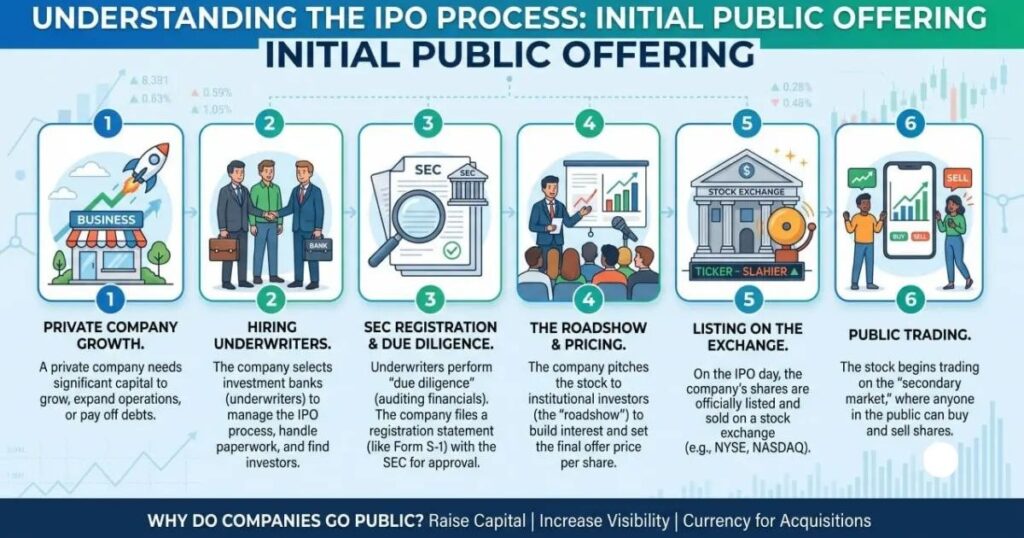
How does a company actually go public? It takes months, but here is the simplified timeline:
-
Hiring an Underwriter: The company hires Investment Banks to manage the legal paperwork.
-
Filing the DRHP: A massive rulebook called the Draft Red Herring Prospectus is submitted to SEBI (the market regulator) containing all financial details.
-
The Roadshow: Company executives market the IPO to big investors to create hype.
-
The Bidding Window (3-5 Days): The IPO opens for the public. You can apply for shares during this time.
-
Allotment: Shares are distributed via a lottery system to the lucky winners. Non-winners get their money unblocked.
-
Listing Day: The shares debut on the stock market and open trading begins!
Pros and Cons of an IPO
Why should you put your hard-earned money into an IPO, and what are the risks involved?
Benefits Of IPO (Why People Love IPOs):
-
The ‘Listing Day’ Jackpot: If the market loves the company, the share price can skyrocket the exact moment it goes live on the stock exchange. This means you could potentially see massive, 50% to 100% profits in just a few days!
-
Catching the Next Big Thing Early: Imagine buying shares of a giant corporate brand before they became stock market superstars. IPOs let you get in on the “ground floor” of a growing company before the rest of the world jumps in.
Disadvantages of IPO for Investors (The Hidden Risks):
-
The ‘Hype’ Trap (Overvaluation): Sometimes, companies use heavy marketing to create artificial hype, pricing their shares much higher than their actual worth. When reality hits on listing day, the stock price can crash instantly, leaving you with a loss.
-
It’s a Game of Luck (Allotment): Because profitable IPOs get crazy demand (oversubscription), getting shares is purely based on a computer-generated lottery. Even if you have the money and do perfect research, you might still go home empty-handed.
How to Analyse an IPO Before Investing?
Don’t just invest because there is hype. Look at these factors:
-
Read the Prospectus (RHP): Understand exactly why the company wants the money. Are they using it to grow, or just to pay off old debts?
-
Check the Promoters: Who is running the company? Do they have a good track record and clean background?
-
Understand the Business Model: Only invest in businesses you understand. How do they make money?
-
Look at Financial Health: Are their revenues and profits growing year over year?
-
Check the GMP (Grey Market Premium): GMP is the unofficial premium at which IPO shares are trading before they list. A high GMP usually indicates strong listing gains, though it is not a guarantee.
Key SEBI Rules for IPOs You Should Know
SEBI (Securities and Exchange Board of India) acts as the referee to protect retail investors like you.
-
Minimum Subscription: An IPO must receive at least 90% subscription. If it doesn’t, the IPO fails, and the company must return all money to the investors.
-
Retail Quota: SEBI mandates that a specific percentage of the IPO (usually 35%) must be reserved strictly for Retail Individual Investors (people investing less than ₹2 Lakh).
-
Lock-in Period: Promoters (founders) cannot sell their shares immediately after the IPO. This prevents them from dumping shares and crashing the price.
🚩 3 Major “Red Flags” to Watch Out For in an IPO
Most beginners only look at the grey market hype. Smart investors look for warning signs. If you see these in a company’s prospectus, be very careful:
-
Massive OFS (Offer for Sale): If an IPO is 90% or 100% OFS, it means the founders and private equity funds are just cashing out. The company itself gets ₹0 for actual business growth.
-
Raising Money Just to Pay Debt: If a company is drowning in bank loans and is launching an IPO just to pay off old lenders so it can survive, it is usually a bad sign for new investors.
-
Sudden, Suspicious Profit Jumps: If a company was making heavy losses for 3 straight years, but magically shows massive profits just 6 months before announcing the IPO, it might be “window dressing” (manipulating numbers to look good).
💰 How Are IPO Profits Taxed in India?
Many beginners forget that if you make a profit on listing day, you have to pay tax! Here is the simple math for equity shares:
-
Short-Term Capital Gains (STCG): If you sell your IPO shares within 1 year of the listing date, your net profit will be taxed at 20% (plus applicable cess).
-
Long-Term Capital Gains (LTCG): If you hold the shares for more than 1 year, your profits up to ₹1.25 Lakh per financial year are completely tax-free! Any profit above that limit is taxed at 12.5%.
📸 The 60-Second IPO Checklist (Screenshot This!)
Do not hit the ‘Apply’ button until you can check off these 6 golden rules:
-
✅ 1. Is it a Money-Maker: Look at the last 3 years of financial data. Consistent profits? Great! Heavy losses? Stay away!
-
✅ 2. What’s the Money For: Expanding the business = 🟢 GREEN FLAG. Paying off old bank loans = 🔴 RED FLAG.
-
✅ 3. Who Keeps the Cash: ‘Fresh Issue’ (Money goes to the company) = 🟢 GREEN FLAG. ‘100% OFS’ (Founders are just cashing out) = 🔴 RED FLAG.
-
✅ 4. Are the ‘Whales’ Buying: Check the subscription status on Day 3, If big institutions (QIBs) are investing heavily, it’s usually a safer bet.
-
✅ 5. Is the Market Buzzing: Check the GMP (Grey Market Premium) online. A high GMP usually hints at a listing day jackpot!
-
✅ 6. The Golden Rule: Always tick the ‘Cut-Off Price’ box on your brokerage app to guarantee your application doesn’t get rejected.
Final Thoughts: Ready for Your First Investment?
By now, you should have a clear answer to what is IPO in stock market and how it can be a game-changer for your investment portfolio. While the massive listing gains are definitely attractive, remember that smart investing is all about avoiding the major red flags and doing proper research. An IPO is not a guaranteed lottery, but with the right strategy, it can highly reward patient investors.
Over to You!
Are you planning to apply for any upcoming IPOs this month, or will you stick to regular stocks? Drop a comment below and share your thoughts and follow —I’d love to know your strategy!
Frequently Asked Questions (FAQs)
1. What happens if my IPO application is rejected or I don’t get shares?
Answer: Your money is completely safe. When you apply, your funds are only “blocked” in your bank account via ASBA. If you don’t get the shares, the block is removed automatically, and you can use your money normally.
2. Can I sell my IPO shares on the very first day?
Answer: Yes! If you are allotted shares, you can sell them the second the market opens on listing day (this is called “flipping”).
3. Is it guaranteed that an IPO will make a profit?
Answer: No. While many give great listing gains, some list at a “discount” (lower than the issue price), which means you could lose money instantly. Always do your research.
4. What documents do I need to invest in an IPO?
Answer: To apply for an IPO in India, you basically need three things: a PAN card, an active bank account (for UPI mandate or ASBA), and a Demat account with any SEBI-registered broker like Zerodha, Groww, or Upstox.
5. What does “Cut-off Price” mean, and should I use it?
Answer: An IPO usually comes with a price band (e.g., ₹100 to ₹105). The “Cut-off price” is the highest price in that band. To maximize your chances of getting an allotment in a popular IPO, it is always highly recommended to tick the “cut-off price” box while applying.
6. What is Grey Market Premium (GMP)?
Answer: GMP is the unofficial price at which IPO shares are traded before they are officially listed on the stock exchange. While a high positive GMP indicates strong market demand and hints at listing gains, it is purely speculative. You should never invest in an IPO solely based on its GMP.
7. How are IPO shares allotted if too many people apply?
Answer: If an IPO is “oversubscribed” (which means the company received more applications than the available shares), the allotment for retail investors is done through a computerized lottery draw. In such cases, getting the shares purely depends on your luck!